
Snowflake Natural Language Analytics: A Buyer’s Guide
Compare native Snowflake AI and connected assistants for business users. Use a practical decision scorecard, margin test and cost checklist before choosing.
Snowflake natural language analytics lets business users ask warehouse questions without writing SQL. Choose a tool by the workflow your team can support: Snowflake’s native conversational application and agents, a custom application over those agents, or a connected assistant such as AskYourDatabase. Compare metric consistency, effective access, useful answers and operating cost before comparing interface polish.
If your business definitions already live in Snowflake, evaluate the native route first. If you need a particular Desktop workflow or a common interface for separately connected databases, include a connected assistant. Neither choice removes the need for data ownership and result review.
AskYourDatabase publishes this guide and is one of the options discussed. This is a decision framework, not an independent ranking or a tested accuracy comparison. Product documentation was reviewed on October 8, 2026. For connection fields, authentication and warehouse troubleshooting, use the separate Snowflake chatbot setup guide.
Compare three operating models
| Decision | Native conversational application | Custom application using Cortex Agents | Connected assistant: AskYourDatabase |
|---|---|---|---|
| Best reason to evaluate | Keep the analytics experience close to an existing Snowflake operating model | Build a specific application experience | Use AYD’s chat workflow and supported database connectors |
| Interface ownership | Snowflake supplies the application | Your team builds and maintains the interface | AYD supplies the product interface |
| Business meaning | Evaluate your semantic definitions and agent configuration | Your application still needs approved metric context | Supply schema descriptions and examples; verify which objects are discovered |
| Access review | Test the actual user, roles and configured agent tools | Test application identity propagation and database access | Test the connection identity plus application controls |
| Operating work | Maintain definitions, permissions and evaluation cases | Also own application code, authentication and monitoring | Maintain connections, training context and deployment configuration |
| Decision evidence | Correct answers under intended user roles | Correct answers plus reliable application behavior | Correct answers plus an approved processing and identity path |
These are architectural choices, not a claim that one product wins every category. A custom interface can be appropriate when the interaction itself is part of your product; it also creates work that a ready-made interface may avoid. Multiple supported database connectors do not establish federated joins across databases.
Snowflake’s current conversational application documentation describes Snowflake CoWork, a business-user interface using data agents, with charts and traceability. The older Snowflake Intelligence documentation URL currently redirects there. Check the naming and capabilities in your account rather than treating every “Snowflake AI” reference as the same service.
Cortex Analyst addresses structured-data questions; Snowflake now recommends transitioning to Cortex Agents. The agent setup documentation covers building an agent and calling it from an application. Having an API available does not mean a complete business-user workflow has already been deployed.
Decide who owns the meaning of a question
A business user asking “What was our margin?” has not specified a complete calculation. Before trying tools, agree the revenue basis, eligible transactions, cost basis, currency, reporting calendar and handling of missing values. A convincing explanation of the wrong metric is still a failed answer.
Snowflake semantic views represent business entities, dimensions, facts, metrics and relationships in database objects. If your team maintains these definitions, ask how each candidate consumes them. Do not assume a third-party connector imports semantic metrics merely because it connects to Snowflake.
The AYD connector reviewed for this guide inspects ordinary tables, views and materialized views. That code path does not establish automatic semantic-view discovery or reuse of metric definitions. If reuse is required, verify it explicitly before purchase. Otherwise, have the data owner approve a reporting view and corresponding AYD context, with a plan to keep both definitions aligned.
Use this short contract in every candidate:
- Question family: September 2026 gross margin by product, using the approved reporting snapshot.
- Grain: one summarized row per product and currency in the evaluation data.
- Formula: total gross profit divided by total revenue, not the average of product percentages.
- Scope: USD only unless the user explicitly selects another currency; no implicit FX conversion.
- Unknowns: missing cost means the full margin is unknown; zero revenue means the ratio is undefined.
- Evidence: show the included scope, calculation and source objects, then let the owner reconcile the answer.
For broader rollout ownership, use the natural language querying readiness guide. This article focuses on choosing a Snowflake analytics workflow, while that guide covers team preparation across databases.
A small margin test that reveals a large mistake
The following synthetic reporting snapshot is deliberately small. Amounts are integer cents; costs use the same currency as revenue. It is an editorial reference exercise, not a customer dataset, Snowflake execution result or AI benchmark.
| Product | Currency | Revenue cents | Cost cents | Gross profit cents |
|---|---|---|---|---|
| A | USD | 10000 | 9000 | 1000 |
| B | USD | 20000 | 15000 | 5000 |
| C | EUR | 5000 | 1000 | 4000 |
Ask: “For this September snapshot, show total USD gross profit and gross margin. Explain how you combine the products.”
The reference is 6,000 cents gross profit on 30,000 cents revenue: 20% margin. Product A’s margin is 10%; product B’s is 25%. Averaging those two percentages gives 17.5%, which answers a different question. Including product C mixes currencies without an approved conversion rule.
The values and following numerical cases were checked locally using exact arithmetic. No query was sent to Snowflake and no AI tool was tested. Download the synthetic reference and expected cases to adapt in an authorized test environment. It is a readable evaluation artifact, not an AYD import format.
| Case | Ask or change | Expected behavior or result |
|---|---|---|
| M1 | Total USD gross profit and margin | 6000 cents and 20% |
| M2 | Follow up: “Only product B,” retaining USD scope | 5000 cents and 25% |
| M3 | New question: report EUR separately | 4000 cents and 80% |
| M4 | Double both revenue and cost for B | USD profit 11000 cents; margin 22% |
| M5 | Set A’s cost to unknown | Explain that full USD margin cannot be determined; do not silently treat unknown cost as zero |
| M6 | Select a product with zero revenue and zero cost | Zero gross profit; margin undefined, not an asserted 0% |
| M7 | Ask for October using only this September snapshot | Request another dataset or state that October cannot be answered |
M5–M7 are proposed handling checks, not observed product responses. Define your own acceptable wording; evaluate the meaning instead of demanding an exact sentence. For M2, record the preceding conversation because the same follow-up in an empty chat has no established scope.
Use the text-to-SQL evaluation kit for a broader result-testing method. Its SQL fixtures have a separate engine and scope; do not present them as Snowflake execution evidence.
Evaluate AskYourDatabase with the same questions
Start with an approved Snowflake reporting scope and a restricted identity. Follow the connection guide, check that expected objects appear, and add the metric contract through schema context and training. Ask the margin question, inspect the generated SQL and reconcile its source rows before requesting a chart.
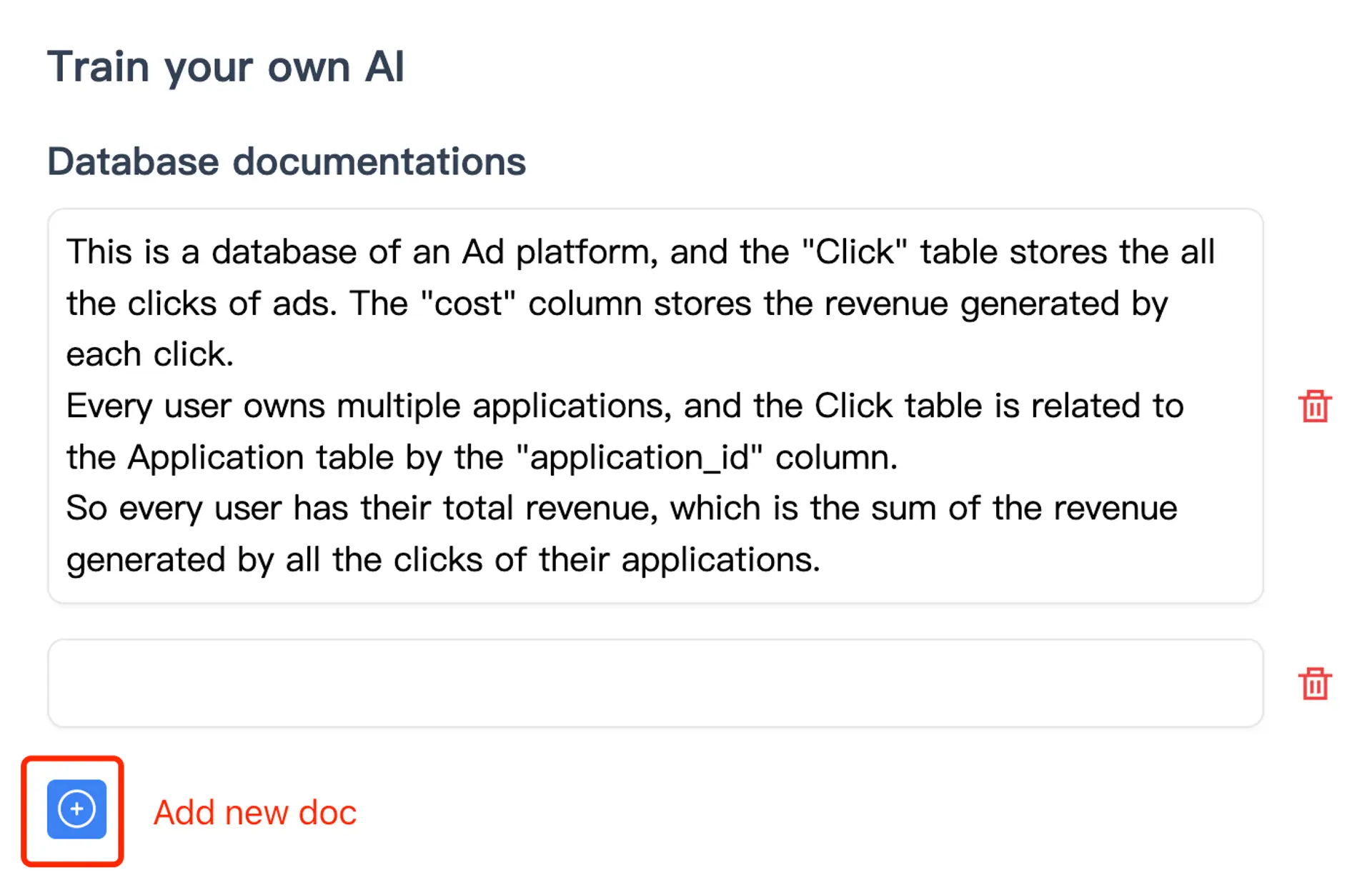
This image illustrates AYD’s context workflow; it is not a screenshot of a completed Snowflake evaluation. Descriptions and examples guide answers but do not enforce permissions or guarantee correctness. Keep held-out questions separate from examples supplied during setup.
For an internal evaluation, review Desktop and download options. For an application chatbot or a private environment, compare plans and deployment choices and the private deployment boundaries. Desktop SQL execution can be local while model requests still use external services; application hosting and inference location are separate choices.
If you also use BigQuery, evaluate that connection separately with the BigQuery workflow. A consistent interface may reduce workflow switching, but this guide has not measured time savings or cross-engine answer quality.
Apply access and data-processing gates before scoring
A tool should not win a purchase decision by producing attractive answers outside the intended access boundary. Agree the permitted tables, rows and columns for each audience. Have the administrator verify the execution identity used by the real session, not just a worksheet opened under a different role.
If a connected application shares a database credential, do not assume Snowflake sees each employee as a distinct database user. Test the actual application access controls, role configuration and row policies. Read-only access limits writes; it can still permit reading too much. A refusal in a chat transcript is insufficient evidence of database enforcement.
Record where the question, schema, SQL, returned values and history are processed or stored. AYD’s security and data-flow documentation explains deployment differences. Apply the same evidence requirement to the native and custom routes, including any configured tools or external services. Mark untested access or processing requirements as unresolved rather than awarding partial points.
Compare total cost per useful workflow
Ask each candidate to answer the same frozen question set with comparable reporting data. Record first attempts, retries, manual repairs and unanswered questions. A low charge for an answer that requires analyst repair does not show a lower operating cost.
Keep four cost lines separate: application fees, warehouse consumption, applicable AI-service charges, and your team’s setup and ongoing maintenance time. Use your actual contract rates and observed consumption; this guide does not supply a universal per-question price.
Snowflake warehouse resource monitors do not cover every serverless cost. Review the controls and billing records for the specific AI services too. Do not treat a returned row limit as proof of a cheap aggregate query, or an application subscription as covering all warehouse usage.
Download the decision scorecard and cost ledger. It leaves all outcomes blank. For each candidate, record version, role, data snapshot, preparation time, first response, SQL or trace, correctness, user clarification, latency, retries and observed cost. Keep correctness and access results separate from usability preferences; do not bury a failed access test in an average score.
Make a narrow, reviewable selection
- Pick one reporting workflow and obtain its approved definitions and reference answers.
- Choose at most two relevant operating models for the first evaluation. Include the native option when it fits your existing Snowflake investment.
- Give both candidates equivalent approved context. Record any product-specific preparation rather than hiding it.
- Run the numerical, ambiguity and access cases in an approved test environment, keeping all outcomes.
- Select a limited pilot only after mandatory requirements pass. Assign an owner to repeat checks when definitions, access or product behavior changes.
If AYD fits those requirements, the next step is an approved Desktop evaluation or a discussion of Enterprise deployment, followed by the Snowflake setup guide. If the native workflow fits better, retain it and use the same evaluation record. For decisions involving other databases, consult the broader database assistant alternatives guide.
Frequently asked questions
Which natural language analytics tool should a Snowflake team evaluate first?
Start with the native route if your reporting and semantic definitions already live in Snowflake and your team can operate its agents. Evaluate a connected assistant when its interface, deployment choices or other database connectors meet a specific need. Use the same business questions and access tests for both.
Are Cortex Analyst, Cortex Agents and a chat interface the same thing?
No. Cortex Analyst supports structured-data questions, Cortex Agents coordinates tools, and a conversational application provides the user experience. Snowflake currently recommends transitioning from Cortex Analyst to Cortex Agents. Confirm the available interface and features in your account.
Does AskYourDatabase automatically reuse Snowflake semantic views?
Do not assume semantic-view discovery or metric import. The connector inspected for this guide discovers ordinary tables, views and materialized views. Validate supported objects and provide approved business definitions through the actual product workflow.
Can a read-only connection separate the data each employee sees?
Read-only access restricts writes but does not by itself separate readable rows. Test the actual execution identity, permitted objects, row policies and application authorization for each audience. A prompt instruction is not an access-control boundary.
What should a Snowflake AI analytics evaluation cost include?
Record application fees, warehouse consumption, applicable AI-service charges, setup and maintenance effort, and retries. Use observed usage and your own rates. A warehouse resource monitor does not cover every serverless or AI charge.
Has this guide benchmarked Snowflake or AskYourDatabase accuracy?
No. The synthetic margin answers were checked with local arithmetic. The scorecard is blank and no Snowflake query or AI product was executed for this comparison. Record actual results in an approved test environment before choosing a tool.