
AskYourDatabase Alternatives: A Practical Guide (2026)
Compare AskYourDatabase alternatives by workflow, deployment, data handling, and operating cost. Use a scorecard to test a replacement before switching.

BlazeSQL, Vanna, and DBeaver AI Assistant are three AskYourDatabase alternatives to consider for different jobs: managed analysis, building a custom SQL agent, and working inside a database client. Choose by the workflow you need to replace, then compare data handling, permissions, and answers on the same dataset. A tool that drafts good SQL may still be the wrong replacement for a customer-facing chatbot.
Disclosure: This guide is published by AskYourDatabase, one of the products discussed. It was prepared with AI-assisted research of the vendor documentation linked below on September 23, 2026. We have not run a comparative product benchmark, and the ordering is not an accuracy ranking. Prices and edition availability can change.
Start with the job, not a list of AI tools
Write down why you are evaluating a replacement. “We need AI” is too broad to test. “Our support team needs to answer account-level usage questions without seeing another customer's records” identifies both the workflow and an acceptance condition.
| Your main requirement | Shortlist direction | Evidence to collect before buying |
|---|---|---|
| A team wants managed conversational analysis and reporting | BlazeSQL; compare with the appropriate AskYourDatabase product | Business definitions, sharing behavior, total seats, and permitted data processing |
| Engineers want to own a SQL agent and its application integration | Vanna | Identity integration, tool permissions, deployment ownership, and model configuration |
| Analysts want AI help within an existing SQL client | DBeaver AI Assistant | Required edition, provider configuration, SQL review, and allowed tool actions |
| Customers need an embedded analytics conversation | Evaluate the specific embedded offering or build path | Backend authentication, tenant-bound sessions, joins, exports, and session expiry |
| Policy prohibits external model processing | Evaluate a complete local-model architecture | Model endpoint, all outbound dependencies, logs, storage, and operational ownership |
These are shortlist directions, not guarantees that a vendor meets your requirements. If the actual problem is inconsistent definitions of revenue or active customers, changing tools alone may preserve the same error. Document those definitions before starting a trial.
1. BlazeSQL: consider a managed analytics workflow
BlazeSQL offers individual and team products, desktop access, dashboards, and a separate white-label embedded analytics offering. It belongs on a shortlist when you want a managed analytics product rather than maintaining an agent framework.
Its current individual pricing lists Pro at $150/month and Advanced at $250/month. The team page lists Team at $400/month and Team Advanced at $800/month, each including three users, with custom Enterprise terms. Check which plan covers your embedding, API, and additional-user requirements. These public prices are not a quote for an equivalent deployment.
The important privacy distinction is the selected mode. BlazeSQL's privacy policy describes local desktop results when offline mode is enabled and result transmission when it is disabled. It also describes cloud-stored schema metadata, chat messages, and encrypted database credentials, with authentication-specific exceptions. “Offline mode” therefore should not be interpreted as an entirely offline AI stack. Enterprise self-hosted result storage is also a narrower claim than self-hosting the whole service.
For detailed product-to-product evaluation, use our existing AskYourDatabase vs BlazeSQL comparison. This guide focuses on choosing among different replacement architectures.
2. Vanna: consider a developer-owned SQL agent
Vanna 2.0 is a user-aware agent framework. Its open-source repository includes a web component, streaming results, and an agent-based API under an MIT license. Do not evaluate it using old descriptions that assume every interface must be built from scratch or only discuss the earlier VannaBase API.
Vanna's product page offers cloud and self-host paths, configurable models, and optional hosted administration. Its pricing page lists Explorer at $50/month with 20 questions/day, Team at $500/month with 300 questions/day, and custom Enterprise arrangements. Separate those hosted plan limits from the open-source code license and your own infrastructure costs.
Our assessment: this is a relevant alternative when your team wants to own application integration and has someone responsible for operating it. A framework provides components; your deployment still needs acceptance tests, monitoring, upgrades, and clear incident ownership. Choose the actual model, memory, identity, and storage configuration before describing the system as private.
Ask the engineer running the evaluation to demonstrate one permission-denied case and one schema-change case, not only a successful sample question. That reveals whether the team can diagnose failures in the stack it will maintain.
3. DBeaver AI Assistant: consider a database-client workflow
DBeaver AI Assistant adds natural-language help to a database client, including chat and SQL-related capabilities. Features and providers have edition requirements; check those badges before assuming a capability is included in a free edition.
Its data-privacy documentation describes sharing schema names with the configured AI provider and controlling the metadata scope. Its Ollama integration guide lists Lite, Enterprise, and Ultimate availability and configuration of an Ollama server. A model hosted on an approved local server can be part of a local inference design; verify the endpoint and enabled features rather than assuming every configuration is local.
Our assessment: shortlist this path for people who already work with SQL and want AI assistance in their database workspace. It is a different replacement scope from delivering a chatbot to customers inside your SaaS application. Include the necessary client edition, any external model usage, and local model hardware in your cost calculation. Do not compare a client license alone with a fully operated embedded service.
When keeping AskYourDatabase is the better scope decision
If you need a ready-made conversational workflow, first check whether you are using the right product mode. AskYourDatabase Desktop connects from your computer. The embedded analytics chatbot is intended for a website or application workflow, with documented backend session creation and access-control configuration.
For a fair evaluation of AskYourDatabase:
- Prepare an approved read-only reporting connection using the connection guide.
- Add a short business glossary and reviewed question/SQL examples using training. Define time zones, statuses, currencies, and join keys explicitly.
- Ask a known-answer question, inspect the result, and follow up with a narrower date or customer segment.
- Review the plan and product mode needed for your users and workload. A Desktop seat and a hosted chatbot allowance are different purchasing units.
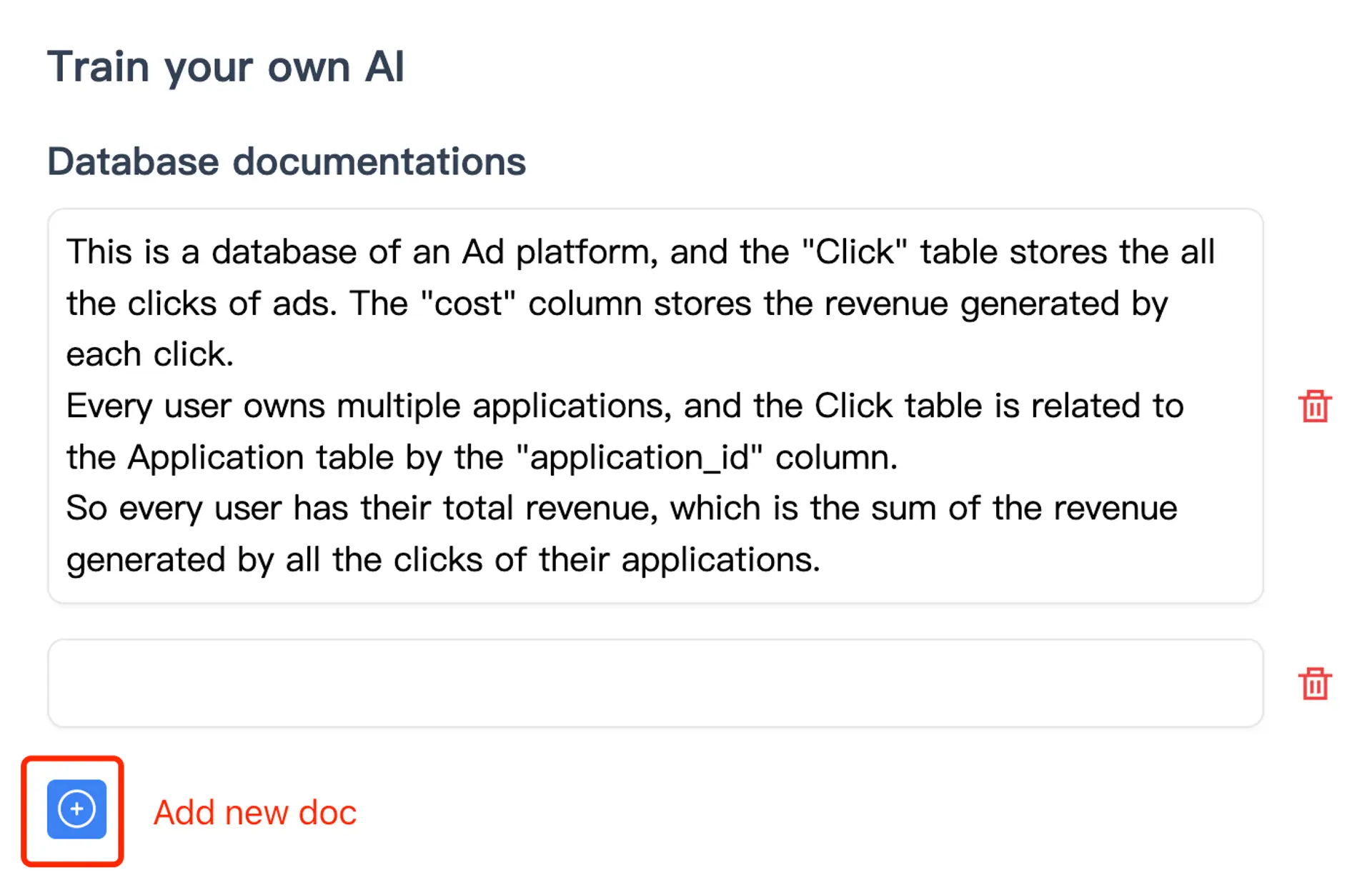
The screenshot shows AskYourDatabase's training interface, not an output from the cross-vendor evaluation described here. Check security and data flow before adding sensitive data: local database execution does not mean all AI processing stays on the device. For private deployment, scope application hosting and model inference separately with the enterprise team; do not infer isolation from a product label.
A reusable replacement scorecard
Decide the pass conditions before opening trials. Use two sheets in your evaluation notes: a hard-requirements table and a quality table. A failed permission or data-location requirement should not be averaged away by fast answers.
Hard requirements: pass, fail, or not verified
| Requirement | Evidence to retain | Acceptance condition |
|---|---|---|
| Approved connection | Selected engine, role, endpoint, and tested network path | Only approved data is reachable |
| Tenant isolation, if applicable | Separate A/B sessions, SQL, and returned results | No cross-tenant rows, aggregates, or exports |
| Restricted operations | Test-role grants and attempted write behavior | Unauthorized changes are blocked by enforced permissions |
| Data location | Diagram for credentials, schema, prompts, rows, history, and logs | Every processing location matches the approved policy |
| Support and operations | Owner for failures, upgrades, and restoration | Named staff can support the intended deployment |
Mark missing evidence as not verified, rather than passing it because a demo worked. Use only synthetic or approved test data during evaluation. Do not deliberately probe production permissions with destructive commands.
Quality: record results, not impressions
Build ten representative questions: four everyday questions, two join cases, two date/currency cases, one ambiguous request, and one unauthorized request. For each candidate, record the exact prompt, relevant context, generated SQL where available, expected answer, actual answer, elapsed time, and any manual correction.
Score answer correctness only on the eight questions with determinate numeric answers. Record the ambiguous request and access-denial case separately. This prevents a system from getting credit for confidently guessing an unspecified business rule, or being penalized for correctly refusing inaccessible data. Repeat failed cases after changing context, keeping the original results so you can see the cost of correction.
For example, “eight out of eight numeric answers matched after three manual corrections” says more than “100% accurate.” Record initial and corrected results separately. These are proposed scoring rules, not measured results for the products above.
A small known-answer exercise you can adapt
Use this synthetic fixture to check whether an evaluation respects join grain and tenant boundaries. It is a manual reference exercise, not a product test. Assume paid USD orders only and refunds posted before September 1, 2026.
| Tenant | Order | Paid amount | Refunds before cutoff |
|---|---|---|---|
| A | 101 | 100 | Two refund rows: 10 and 15 |
| A | 102 | 60 | None |
| B | 201 | 900 | One refund row: 100 |
Ask: “For tenant A, what is paid order value minus refunds before September 1?” The reference is 100 + 60 − 10 − 15 = 135. Tenant B's reference is 800. The authorized result for tenant A must not include B. If all rows are legitimately visible to an administrator, the combined reference is 935.
A direct join from orders to the two refund rows duplicates order 101. Summing raw joined order amounts for A produces 260 rather than 160, so even executable SQL can be wrong. The reference implementation should aggregate refunds per order before joining, or otherwise preserve order grain. Do not treat a plausible explanation as proof the aggregation is correct.
Then change one thing at a time: move one refund after the cutoff, ask for an unknown tenant, or replace “paid value” with undefined “revenue.” Write the expected behavior before asking the assistant. For an engine-specific executable example, see the MySQL chatbot guide; for broader definition and validation guidance, see natural-language database queries.
Compare total operating cost and plan a reversible migration
Use a common workload when estimating cost: the same users, expected daily questions, embedding scope, retention requirement, and support coverage. Record vendor subscriptions, additional seats, model usage, hosting, database-query compute, and staff time separately. A self-hosted framework can remove one subscription while adding maintenance; a managed product can reduce setup work while imposing plan limits.
Before switching, inventory the knowledge that makes the current assistant useful: business definitions, approved SQL examples, table comments, access rules, saved outputs, and connection requirements. Do not assume these have a one-click import into another product.
- Capture the baseline. Save reviewed questions and expected answers. Separate failures caused by missing context from missing capabilities.
- Configure a test replacement. Use restricted test credentials and rebuild access rules for the candidate's architecture.
- Run parallel acceptance checks. Keep the original workflow available while intended users try the new one.
- Approve the cutover. Confirm who supports it, what happens when quotas are reached, and how to restore the old workflow if necessary.
- Retire old access deliberately. Follow your organization's credential and retention process once the migration has been accepted.
The next step is a bounded evaluation, not buying every tool. If AskYourDatabase remains in your shortlist, compare Desktop, Website Chatbot, and Enterprise plans, then test the chosen mode with your known-answer questions. If a different architecture fits better, use the linked primary documentation to validate that path before committing.
Frequently asked questions
Which AskYourDatabase alternative should I evaluate first?
Start with the workflow you need to replace. Consider BlazeSQL for a managed analytics workflow, Vanna for a developer-owned SQL agent, and DBeaver AI Assistant for work inside a database client. Validate the exact edition, permissions, data flow, and business questions before choosing.
Is there an open-source alternative to AskYourDatabase?
Vanna publishes its core framework under the MIT license. Hosting, model inference, maintenance, and optional hosted administration still have costs. Open-source code does not automatically make the complete deployed system private or free to operate.
Does a desktop database assistant keep all data offline?
No. The database connection, model inference, credential storage, and conversation storage are separate paths. Review each path and the configured model provider. AskYourDatabase Desktop uses local database access but can send questions and necessary response data for AI analysis.
Can I replace an embedded database chatbot with a SQL editor?
A database editor does not by itself replace customer authentication, session creation, tenant isolation, and an embedded user interface. Test these application requirements separately from SQL generation when selecting a customer-facing replacement.
How should I compare AI SQL accuracy?
Use the same documented business definitions and approved dataset for every candidate. Compare generated SQL and numeric results with a reviewed reference, include date and join edge cases, and record clarification and access-denial behavior. This guide does not report a vendor accuracy benchmark.
What should I migrate when changing database assistants?
Inventory business definitions, approved SQL examples, access policies, connection requirements, and saved outputs. Rebuild vendor-specific settings, validate them with separate test accounts, and keep the old workflow available until the replacement passes your acceptance cases.