AskYourDatabase vs BlazeSQL: Pricing & Deployment (2026)
Compare AskYourDatabase vs BlazeSQL pricing, desktop data flow and embedded deployment. Use a five-user budget example and a practical evaluation worksheet.

AskYourDatabase and BlazeSQL both turn natural language questions into database queries. If you are considering AskYourDatabase as a BlazeSQL alternative, start with your deployment and access requirements, then test query correctness on your own schema. Neither a feature list nor a fluent AI answer establishes which product will work better for your data.
Start with the pricing and five-user example, check desktop data flow, then complete the replacement worksheet.
Disclosure and scope: This comparison is published by AskYourDatabase. It was substantially updated on October 29, 2026 using linked product documentation and public vendor pages, with AI assistance for research and drafting. It is a documentation comparison, not a hands-on benchmark of BlazeSQL. Features and commercial terms can change; confirm requirements during your evaluation.
AskYourDatabase vs BlazeSQL at a glance
| Decision | AskYourDatabase | BlazeSQL |
|---|---|---|
| Desktop workflow | Local database connection, credentials, and query execution; AI requests use a provider | Desktop app is available, alongside web and Database Connection API options |
| Query results and AI | Necessary response data can be sent to the AI provider for analysis | Desktop offline mode keeps results local; disabling it enables result-based AI analysis |
| Customer-facing analytics | Documented iframe sessions, context variables, and row-level policies | Advertises embedded analytics and user/database management APIs |
| Private deployment | Documented self-hosted application and separately scoped isolated-model options | Enterprise lists self-hosted result storage; confirm application and model hosting separately |
| Business context | Documentation and question/SQL examples can be added | Documents a knowledge base and learning from feedback |
| Choosing a plan | Separate desktop and chatbot pricing pages | Separate individual and team pricing pages |
Sources: AskYourDatabase security, access control, training, and private deployment documentation; BlazeSQL product overview, privacy policy, and embedding offering. Read the data-flow details below before treating “desktop” as a privacy guarantee.
For a broader shortlist across managed analytics, developer frameworks, and SQL clients, use our AskYourDatabase alternatives guide. It includes a replacement scorecard and migration checklist.
Compare credentials, query results, and model requests separately
A useful security comparison asks three different questions: where the database password is stored, where SQL executes, and what reaches the language model. Keeping one of these local does not imply that all three stay local.
AskYourDatabase's security documentation describes desktop credentials and database execution as local. It also says necessary response data is sent to the AI provider for explanation and analysis. The hosted chatbot uses a different architecture: it stores encrypted credentials and conversation records. Choose the product mode that matches your organization's data policy.
BlazeSQL's privacy policy, dated February 9, 2026, says database credentials are encrypted on its servers across deployment models, with exceptions for SQL Server Windows and Entra authentication. It describes desktop results as local with offline mode enabled, while schema metadata is transmitted. Disabling offline mode sends results for deeper analysis.
For either product, document the flow of credentials, schema, prompts, result rows, and chat history. Ask which optional features change that flow. Begin with a database role restricted to approved read-only views; a prompt asking the AI to “only read data” is not a substitute for database permissions.
Distinguish a desktop client from private deployment
AskYourDatabase's on-premise documentation distinguishes hosting the application yourself while calling external model providers from running a language model within your own infrastructure. The latter needs a separate hardware and operations assessment. Self-hosting the application alone does not establish that model inference is isolated.
BlazeSQL's enterprise pricing lists self-hosted query-result storage. That does not by itself establish a fully self-hosted application or model. The current pages reviewed here do not establish a complete private-stack option; confirm the proposed architecture with the vendor rather than treating an omitted feature as proof it is unavailable.
Before choosing private deployment, write an acceptance checklist: allowed outbound connections, model endpoints, license validation, backups, logs, upgrades, and incident ownership. A solution only meets the requirement if the deployed configuration passes that checklist.
Evaluate embedded analytics with tenant-isolation tests
Both vendors describe embedding capabilities, so embedding alone does not settle the choice. AskYourDatabase documents chatbot embedding and row-level access policies; BlazeSQL describes backend-created session URLs, user/database management and row-access filter IDs on its white-label product page.
In AskYourDatabase, your backend creates the chatbot session and supplies trusted context variables. Row-level policies then use that context to limit accessible records. Keep session-creation secrets on the backend, and derive customer identity from your authenticated application instead of accepting an arbitrary customer ID from browser input.
Use two synthetic tenants during evaluation. Give tenant A and tenant B different orders, then ask each session for totals, exports, and another tenant's records. Check aggregates as well as raw rows: a chart that combines both tenants can disclose data even without listing individual records. Test hidden tables, joins, follow-up questions, and expired sessions. Run the same acceptance cases against each candidate's configured access controls.
Test SQL accuracy with business questions, not a generic demo
An AI SQL tool can produce valid SQL with the wrong business meaning. Your evaluation should distinguish syntax errors, incorrect joins, missing filters, and ambiguous definitions. Use an analyst-approved baseline before judging the explanation or chart.
Here is an illustrative test set for a subscription business. These are proposed evaluation cases, not measured results from either product.
| Question to ask | What to verify in SQL and results |
|---|---|
| “Show monthly net revenue for the last six complete months.” | Excludes the current partial month; applies your refund, tax, currency, and timezone rules |
| “Which ten customers had the highest paid revenue last quarter?” | Uses paid transactions, correct customer joins, and a stable ordering for ties |
| “How many customers placed no orders this month?” | Includes customers without matching orders; does not lose them through an inner join |
| “Now show that by region, excluding test accounts.” | Preserves the earlier metric definition while applying the new grouping and exclusion |
| “Show only the signed-in customer's orders.” | Enforces access outside the prompt and does not expose another customer's rows or totals |
Run an initial round with identical schema access and questions. Then add the same business definitions and approved SQL examples to both tools and repeat. Record correct answers, incorrect answers, clarifying questions, manual edits, and response time. Do not combine these into an invented accuracy percentage unless you have a defined denominator and reproducible results.
Also inspect query cost. A correct answer that repeatedly scans a large warehouse table can be unsuitable for everyday use. Apply database timeouts and resource limits appropriate to your environment, and ask a database owner to review expensive queries.
How to evaluate AskYourDatabase on your schema
- Connect a restricted dataset. Use a sample database or read-only reporting views and follow the connection guide. Confirm that the selected connector and authentication method fit your environment.
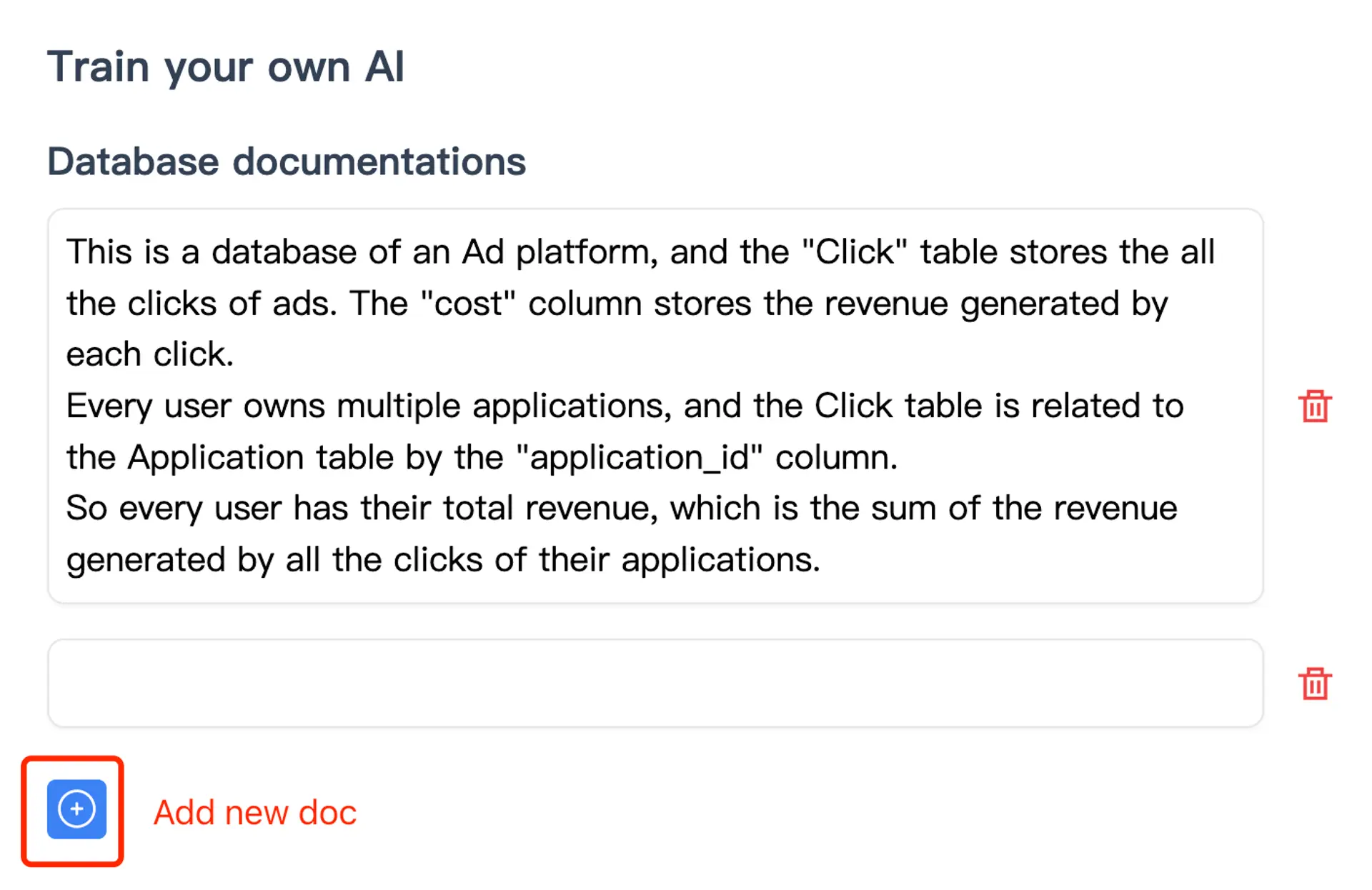
- Add business definitions. In training, explain terms such as “active customer” and “net revenue,” then add approved question/SQL examples. Schema names alone cannot define those metrics.
- Ask, inspect, and refine. Run the evaluation cases, inspect the SQL and result, and try a follow-up that changes one condition. Use the SQL query generator guide for prompt examples and review steps.
- Check the output workflow. Try the chart or export your team actually needs. If the goal is an embedded customer experience, repeat the tenant-isolation tests before connecting production data.
For database-specific setup, see our PostgreSQL chatbot guide and MySQL chatbot guide. For broader evaluation, read practical AI database querying.
Pricing: compare the workflow before the monthly total
Public USD monthly prices checked October 29, 2026. These are subscription inputs, not equivalent feature bundles or a negotiated quote. Annual billing, tax, database compute, implementation and separately agreed services are outside the examples.
| Product and plan | Published monthly price | What the price helps you evaluate |
|---|---|---|
| AskYourDatabase Desktop | $49 per seat | Individual connected analysis; separate from the Website Chatbot subscription |
| AskYourDatabase Website Chatbot Scale | $149; 1,000 questions included, then $0.15 each | A hosted database-chat workflow; check chatbot count and branding requirements |
| AskYourDatabase Website Chatbot Established | $329; 1,500 questions included, then $0.15 each | Additional chatbot capacity and custom branding; review the plan's actual scope |
| BlazeSQL Pro / Advanced | $150 / $250 | Individual analysis; Advanced lists reporting emails, Python analysis and embeddable dashboards |
| BlazeSQL Team | $400 for three users; $50 per additional user | Team analytics, dashboards, agent reports and listed workplace integrations |
| BlazeSQL Team Advanced | $800 for three users; $75 per additional user | Listed advanced agent features, API/MCP and white labeling |
| Enterprise | Custom for both vendors | Agree deployment, support, identity and feature requirements in the proposal |
Sources: AskYourDatabase Desktop and Website Chatbot; BlazeSQL individual and team plans. BlazeSQL's individual page uses different wording about extra Team users; the Team calculations below use the explicit additional-user rates on its dedicated team page. Confirm your quote before committing.
Worked budget: five internal analysts
Five AskYourDatabase Desktop seats billed monthly total 5 × $49 = $245/month. Five BlazeSQL Team users total $400 + 2 × $50 = $500/month. Five Team Advanced users total $800 + 2 × $75 = $950/month. These calculations do not show that Desktop replaces a shared reporting platform: first verify the exact dashboard, collaboration, delivery and integration tasks your five analysts need.
Change the task to customer-facing chat and the seat comparison no longer answers the question. For example, AskYourDatabase Scale at 1,200 questions is $149 + 200 × $0.15 = $179/month, within that plan's feature and chatbot limits. If custom branding is mandatory, evaluate Established instead: at 1,200 questions its listed monthly subscription remains $329. Ask BlazeSQL to confirm the applicable embedded plan and how external identities are billed; do not assume five internal seats cover every customer.
Keep implementation costs separate. Record who prepares reporting views, maintains metric definitions, tests permissions, handles schema changes and owns database query charges. Use the AskYourDatabase plan-cost guide for additional usage cases. A lower subscription total is useful only after the required workflow passes evaluation.
Replacing BlazeSQL: a small, reversible evaluation
If your current workflow already answers correctly and fits your requirements, switching may add work without improving the result. Write down the specific reason for evaluating a replacement: a deployment requirement, a missing workflow, correction effort or a budget constraint. Then test that requirement with the same data scope in both products.
Download the blank comparison worksheet. It is a planning template, not a product benchmark or an automatic migration tool.
| Item to carry into the trial | What to record | Acceptance evidence |
|---|---|---|
| Connection and identity | Database, authentication method, network route and permitted views | The intended identity connects and cannot reach prohibited data |
| Business context | Definitions, approved SQL examples and follow-up rules | Both tools receive equivalent context; ambiguous questions trigger review |
| Saved outputs | Required queries, dashboard filters, exports and delivery destinations | Rebuild one representative output and reconcile its rows and total |
| Application access | Backend session flow, user-to-tenant mapping and expiry | Two identities pass allowed and denied cases, including aggregates |
| Operating cost | Seats or usage, required plan, database charges and maintenance owner | A written scope and budget for the intended workload |
Do not assume saved dashboards, chat history, training data or access policies import directly between vendors. Inventory what you can export, what must be recreated and what must be reapproved. Keep credentials out of the worksheet. Start with synthetic or approved test data and retain the existing workflow until the replacement's output and access checks pass.
For an answer-quality trial, use the text-to-SQL evaluation kit; for a customer integration, use the embedded chatbot implementation guide. Record unresolved requirements as blockers instead of averaging them into a reassuring score. These tests are an evaluation plan; this article does not report completed tests of BlazeSQL or your deployment.
Which should you choose?
Evaluate AskYourDatabase first if local desktop credential storage, its documented customer-session and row-policy workflow, or a scoped private deployment are central requirements. Validate those requirements against the mode you intend to deploy.
Evaluate BlazeSQL alongside it if its advertised team reporting and dashboard workflow fits your existing process. Include it in the same data-flow, accuracy, and permissions assessment. Its current product scope extends beyond basic SQL generation.
If both pass your mandatory controls, choose using your recorded query results, correction effort, user workflow, and total cost. This comparison does not establish a universal security or accuracy winner.
To start an AskYourDatabase evaluation, download the desktop app, review the pricing options, or inspect the embedded chatbot setup. Use the checklist above to decide whether the trial meets your requirements.
Frequently asked questions
Is AskYourDatabase a BlazeSQL alternative?
Yes. Both help users ask database questions in natural language. Evaluate AskYourDatabase when local desktop credentials, documented chatbot access controls, or private deployment are requirements. Test both against your own schema and approved answers.
Is BlazeSQL cloud-only?
No. BlazeSQL documents desktop, web, and Database Connection API options. A desktop client is not the same as a fully self-hosted application and language model.
Does using a desktop app mean no data leaves my computer?
No. Separate database credentials, schema metadata, prompts, and query results. Verify what each app sends to the model provider and how settings change that flow. Desktop describes the location of the client, not the entire system.
Can both products be embedded in another application?
Yes. AskYourDatabase documents iframe sessions and row-level policies. BlazeSQL advertises embedding and user/database management APIs. Verify the required plan, identity integration, and tenant isolation in a trial.
Which product generates more accurate SQL?
This comparison does not establish an accuracy winner. Run the same questions, metric definitions, and access restrictions in both products; compare SQL and results with analyst-approved answers.
Is AskYourDatabase cheaper than BlazeSQL?
For five monthly Desktop seats, AskYourDatabase lists $245; BlazeSQL Team lists $500 for five users. These are different product bundles. Compare required features, deployment, usage and implementation before treating the lower subscription as a suitable replacement.
Can I automatically migrate BlazeSQL dashboards to AskYourDatabase?
This guide does not establish an automatic importer. Inventory saved SQL, dashboards, business definitions and access policies, then rebuild and validate a representative workflow before switching users. Keep the existing workflow available until acceptance checks pass.