Prepare Your Database Connection String
We currently support multiple types of databases: MySQL, PostgreSQL, SQL Server, BigQuery, Snowflake, and Vertica.
Choose your engine in the database query generator guide for the corresponding query examples and a checked inventory workflow.
Here are some examples:
MySQL
mysql://user:password@host:port/database
For a complete setup and answer-validation example, follow the MySQL AI chatbot guide, including connection troubleshooting and a sales/refunds SQL fixture.
Choosing a client first? Use the MySQL GUI guide to compare conversational analysis with SQL development and check why daily totals can differ between clients.
PostgreSQL
postgresql://user:password@host:port/database
Follow the PostgreSQL AI chatbot guide for connection checks, schema context and a tested example covering reporting time zones and missing dates.
Choosing a client? Use the PostgreSQL GUI guide to compare interfaces and check the active database, role and schema before analyzing results.
MongoDB
mongodb://user:password@host:port/database
SQL Server
Data Source=host;Initial Catalog=database;User ID=user;Password=password;
We use ADO.NET format connection strings - for more details, please refer to Microsoft's official documentation (opens in a new tab).
Choosing an interface first? Compare conversational analysis, SQL development and administration in the SQL Server GUI guide.
Follow the SQL Server AI chatbot setup guide for reporting-view permissions, connection checks, and a T-SQL top-customer example with explicit tie handling.
BigQuery
For BigQuery, you need to prepare two things:
1. Project ID
- You can find it in the credentials JSON file as the
quota_project_idfield - Or from Google Cloud Console: look at the project selector at the top of the page
- The project ID is typically composed of lowercase letters, numbers, and hyphens
2. Credentials JSON
- Please refer to Google's official documentation (opens in a new tab) to obtain your BigQuery credentials JSON
- The credentials should be in JSON format like this:
{
  "client_id": "764086051850-xxxxxxxxxxxxxxxxxxxx.apps.googleusercontent.com",
  "client_secret": "xxxxx-xxxxxxxxxxxxx",
  "quota_project_id": "your-project-id",
  "refresh_token": "1//0exxxxxxx-xxxxxxxxxxxxxxxxxxxxxxxxxxxxxxxxxxx",
  "type": "authorized_user",
  "universe_domain": "googleapis.com"
}
Make sure your Google Cloud account has the necessary BigQuery permissions to read the datasets you want to query.
For a complete evaluation, follow the BigQuery AI chatbot guide to distinguish job and data permissions, check query costs, and validate nested-data totals.
Snowflake
Prepare the account identifier, database, username, authentication details, schema, warehouse and role for your approved reporting identity. The current web form accepts a PEM private key; verify supported authentication in your installed Desktop version and follow your Snowflake account policy.
Follow the Snowflake AI chatbot setup guide for role and warehouse checks, key-pair authentication boundaries, and a worked example that avoids counting historical order versions as duplicate revenue.
Clickhouse
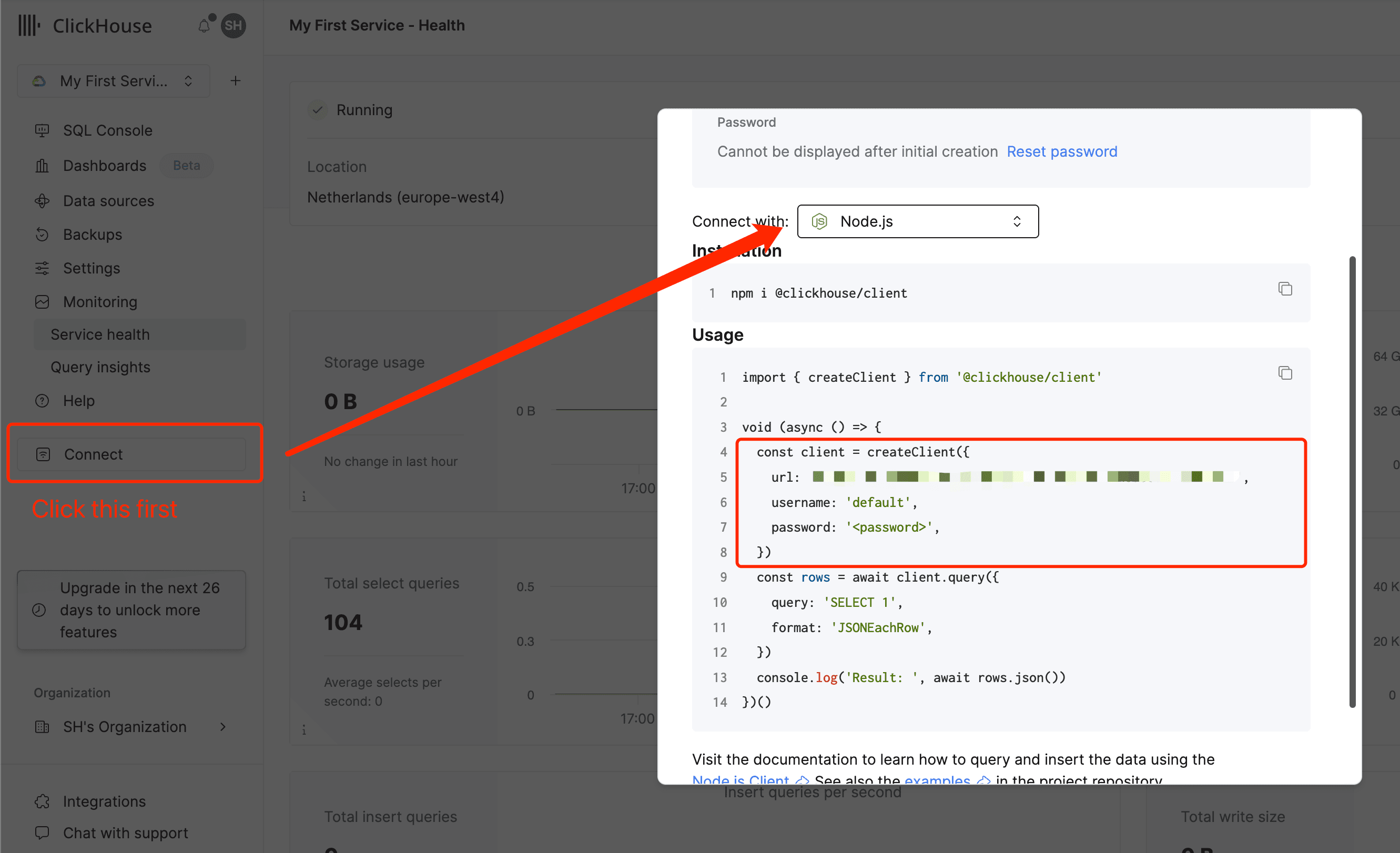
You should input three parameters: url, username, password.
You can find three parameters from your Clickhouse console like this:
Vertica
vertica://user:password@host:port/database
If you encounter any issues while preparing your connection string, we recommend using this utility tool (opens in a new tab).
If you don't have a database and just want to test, you can apply for a free PostgreSQL database at Neon DB (opens in a new tab).
Whitelist Our Static IP (Only Required for Website Chatbot)
You need to whitelist our server IP 43.159.146.204 to allow the Website Chatbot to connect to your database successfully.
If you're unsure how to whitelist an IP, please contact your database provider or your database administrator. (Or ask ChatGPT directly).
If you are using the Desktop app, you can skip this step. (The Desktop app connects to your database from your local computer).
If you are curious about how we connect to your database, you can refer to our security documentation.