AI Analytics Audit Logs: Questions, SQL and Data Access
Compare AI analytics logging scopes and trace a question to executed SQL. Use a synthetic evidence example and checklist to evaluate history, access and exports.

AI analytics audit logs should let a reviewer connect a person's question to the SQL that actually ran and the data-access decision behind the answer. A saved conversation is a useful starting point. It does not, by itself, prove which database identity executed a query, whether a blocked request reached the engine, or whether an export contains every attempt.
Snowflake and Metabase document dedicated AI monitoring surfaces. AskYourDatabase documents Website Chatbot message history and SQL-message retrieval. Their coverage differs. Start with the platform evidence table, then use the worked trace to decide what evidence your evaluation needs.
AskYourDatabase publishes this guide and is one of the products discussed. Documentation was reviewed on November 1, 2026. The downloadable example is synthetic; no live vendor system, customer account or production database was tested. This is a procurement and implementation checklist, not a certification or product ranking.
Compare platform logging scopes
Ask a candidate to show evidence from the exact interface you will use: internal chat, embedded chat, API or another integration. A feature documented for one surface may not cover another.
| Product or layer | Documented starting point | What still needs checking |
|---|---|---|
| Snowflake Cortex Analyst | Request monitoring includes user, question, generated SQL, errors or warnings and request/response information | Correlate generation with execution and object-access evidence. Confirm which monitoring surface applies if using Cortex Agents instead |
| Metabase Metabot | Pro and Enterprise AI usage auditing includes conversation details, tool calls, generated SQL or query-builder queries, and user context | Its AI usage auditing documentation excludes MCP activity. Confirm the actual interface and database-side evidence |
| AskYourDatabase Website Chatbot | Administrators can review message history; the Messages API supports retrieving conversation records with SQL visibility options | Confirm execution correlation, denied attempts, export completeness and retention. This does not establish immutable or comprehensive audit logging |
| Database or warehouse logging | Engine-specific query/job history and access records can identify execution and accessed objects | A service account may represent several application users. Establish the mapping to the person, conversation and attempt |
Snowflake's Cortex Analyst administrator monitoring describes request logs and their access requirements. Its ACCESS_HISTORY documentation separately describes object access and requires Enterprise Edition or higher. Not every query-history entry appears in access history; failed queries are specifically excluded from ACCESS_HISTORY. Therefore, absence there is not a denial verdict. Snowflake currently recommends transitioning from Analyst to Agents; verify that product's monitoring path separately.
Metabase's AI usage auditing documentation describes the paid-plan scope and the MCP exclusion. Its generated-query view is useful evidence, but you should still ask how a displayed query connects to actual execution in your configuration.
For BigQuery, Cloud Audit Logs track administrative and data-access operations. That is database-layer evidence; it does not independently supply the original question from every external AI application. Check the documented events and limitations for the workload you run.
This comparison is deliberately about evidence scope. For a broader product shortlist, use AskYourDatabase alternatives. For choosing between native warehouse conversation and maintained reporting SQL, use the warehouse assistant comparison.
Define the evidence you need before a demo
Write down a review question such as: “Can we identify who requested this result, which scope was allowed, and which query produced it?” Then agree the minimum fields and which system supplies them.
| Evidence | Useful fields or record | Why it matters |
|---|---|---|
| Person and context | Authenticated application user, tenant, role and conversation identifier | Distinguishes the person from a shared database login |
| Request | Request identifier, timestamp with timezone, question or protected reference | Connects a follow-up to the correct turn |
| Generation | Attempt identifier, generated SQL, relevant context/configuration revision | Preserves corrections and retries instead of only the final answer |
| Authorization | Decision, enforcement point, allowed scope and policy revision where available | Separates a model refusal from an enforced access decision |
| Execution | Engine query/job identifier, execution identity, executed SQL and status | Distinguishes a draft from a submitted, failed or completed query |
| Response | Final response reference, row count or protected result reference | Connects the delivered answer to its evidence |
| Review | Reviewer, checked sources, gaps and acceptance decision | Makes unresolved controls visible before rollout |
These are requirements to evaluate, not a claim that any listed vendor automatically emits every field. Record “unavailable” explicitly. If the engine exposes a query identifier but the application does not retain it, document the instrumentation or supported integration needed to close that gap. Matching only timestamps and SQL text can be ambiguous when users repeat a question or the system retries.
Worked example: one question can have several attempts
The invented user analyst-A asks for the number of approved orders in tenant A. The database connection uses a separate service identity. Three request histories illustrate why a transcript alone is insufficient:
| Request | Recorded events | Review conclusion |
|---|---|---|
req-101 | Attempt 1 fails with a syntax error; attempt 2 completes and is linked to the final answer | Preserve both attempts and both engine IDs. One answer does not mean one execution |
req-102 | An application authorization decision denies a request before execution | Record the enforcement point. No engine ID is expected for this illustrated path |
req-103 | SQL generation is recorded, but execution evidence is absent | Status is unknown. Do not relabel this as denied or completed |
Download the synthetic trace JSON and blank evidence checklist. All identifiers and outcomes in the JSON are invented. The file is a teaching format, not an AskYourDatabase API response, database schema or observed security test.
For req-101, the reviewer follows answer_attempt_id to attempt-102, then follows its engine ID to the corresponding successful execution. The earlier failed attempt remains visible. Both records carry the same application request identifier, but each execution has its own identifier. A production design should capture such links where supported instead of reconstructing them from similar timestamps alone.
For req-102, the explicit denial event is the evidence. For req-103, there is no denial event and no execution event. That could mean logging is delayed, incomplete or missing. It cannot establish that no data was accessed. The correct follow-up is to obtain the missing source record or retain an unresolved gap.
The example's identifiers, references and event-state relationships were checked locally. That validates the consistency of this illustration only; it does not test authorization, log completeness or any vendor's AI. Use the separate text-to-SQL accuracy kit when you also need to verify whether an answer is numerically correct.
Review a Website Chatbot conversation in AskYourDatabase
The Website Chatbot guide describes an administrator's messages console. Begin with one approved test conversation and a question whose result your team already knows. Inspect the available messages and SQL evidence, then compare them with the database-side records your deployment exposes.
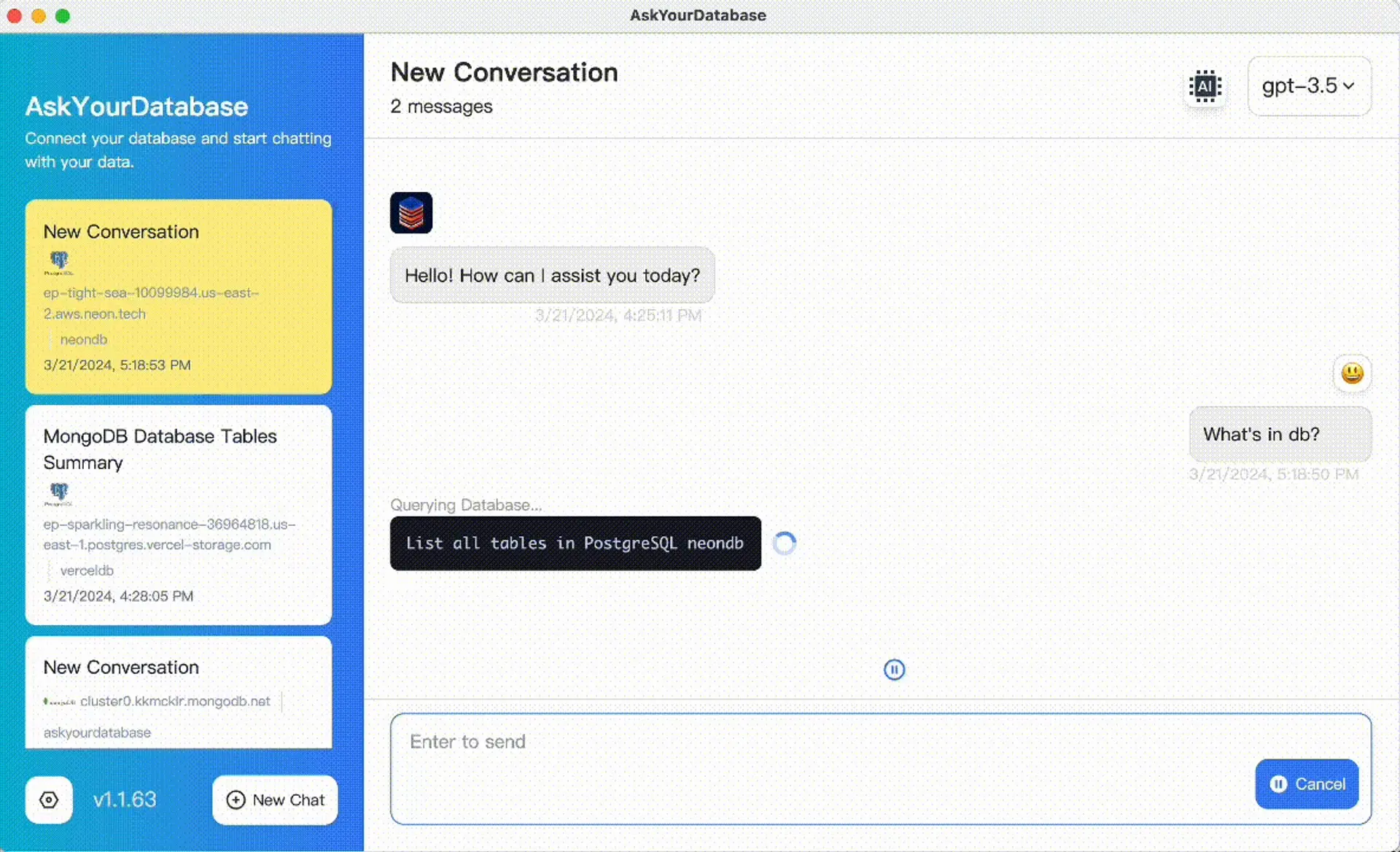
This product screenshot illustrates the conversation interface. It is not an audit console screenshot or a result from the synthetic trace.
For an authorized integration, the Messages API documents GET /api/chatbot/messages, authenticated retrieval using a chatbot ID and chat ID, timestamp pagination and debug=true for SQL messages. Keep API keys on the trusted server side. SQL visibility depends on the request path and configuration; hiding SQL from an end-user interface does not prove that no SQL was executed or stored.
Treat retrieved SQL and result messages as sensitive records. The current endpoint returns up to 20 messages in descending creation order and pages using a strictly earlier timestamp. That is a history-reading interface, not proof of a complete audit export: verify page boundaries, repeated timestamps, duplicates and missing records before relying on an extraction. Ask for a supported export method when completeness is a requirement.
These documented workflows establish conversation review and retrieval. They do not establish automatic warehouse query-ID correlation, tamper-evident storage, complete denial coverage, a fixed retention period or a compliance certification. Review security and data flow, including history and result retention, and confirm required controls for the actual deployment. Desktop and private hosting have different boundaries; do not transfer a hosted Chatbot API claim to every product mode.
Run a focused logging acceptance review
Use synthetic data and an authorized test environment. Define the expected evidence before running these checks, so a missing record cannot be silently reclassified as a pass.
- Trace one permitted question. Start with an authenticated test user, a bounded scope and a known answer. Record the question, each generated attempt, actual execution identity, outcome and final response. Note every unavailable correlation field.
- Test a retry or error path. Choose an approved test case that fails safely in the test environment. Check whether the first failure and later attempt remain distinguishable. Record observed behavior rather than assuming retries are logged.
- Check a denied request. With the data owner's authorization, use a test user that cannot read a synthetic restricted object. Identify the enforcement point and explicit failure evidence. A model's polite refusal alone does not establish database enforcement.
- Review extraction boundaries. Inspect enough synthetic messages to cross a history page. Compare source identifiers, page boundaries and timestamps. Determine what happens if several records share a timestamp or arrive late.
- Review who can read or change the evidence. Confirm authorized log readers, export handling, retention, deletion and any required protection from alteration. Record which controls are contractual, configured, demonstrated or still unknown.
Use the blank checklist to record the product version, plan, interface, evidence locations, owner and acceptance decision. Leave outcomes blank until observed. Do not assign a universal pass rate from this short exercise. The embedded chatbot implementation guide covers the separate user/session isolation design.
Keep the evidence store within your data policy
Questions can contain personal information; SQL literals and tool responses can contain customer data. Logging everything indefinitely may create another sensitive database. Decide which records must be retained, where full content is permitted, and when a protected reference or approved summary is enough.
Separate the ability to use an assistant from the ability to inspect everyone else's conversation history. Likewise, permission to query a warehouse does not automatically imply permission to export its audit records. Document the responsible owner and the required retention and deletion handling for logs, backups and exports. No generic checklist establishes compliance for a specific organization.
If you need a connected chatbot, start with the embedded analytics overview, then review plans and deployment requirements with the team. Bring one test question and the evidence checklist. A useful evaluation ends with demonstrated capabilities and named gaps, rather than an unsupported claim that every action is auditable.
Frequently asked questions
Which AI analytics platforms record questions and generated SQL?
Snowflake documents Cortex Analyst request monitoring, and Metabase documents Metabot conversation and query auditing on Pro and Enterprise. AskYourDatabase provides Website Chatbot message history and a Messages API with SQL visibility options. Verify the exact product, plan, interface and database execution evidence; these are different scopes, not interchangeable audit guarantees.
Is chat history the same as a database audit log?
No. Chat history records application interactions. Database logs record engine-side activity under an execution identity. To reconstruct an answer, connect the question and generated attempts to actual execution records and the final response. A shared database account does not identify the human user by itself.
Does generated SQL prove that a query ran?
No. SQL may be drafted, rejected, edited or retried before execution. Record the attempt status and obtain an engine query or job identifier when available. Keep generated and executed SQL distinguishable.
Does a missing access-history record prove that access was denied?
No. Logging delay, unsupported operations, missing permissions or an incomplete export can explain a missing record. A denial needs an explicit decision or error from the relevant enforcement point. Treat missing evidence as unresolved.
Does AskYourDatabase promise immutable audit logs or automatic warehouse query-ID correlation?
This guide establishes Website Chatbot conversation review and SQL message retrieval, not immutable storage, automatic warehouse query-ID correlation or complete access-denial coverage. Confirm any required retention, export and audit controls for your actual deployment before approving it.
Should an audit record contain full query results?
Decide that with the data owner. A restricted result reference, row count and approved metadata may be sufficient for a review; full result copies can create another sensitive dataset. Protect prompts, SQL literals, exports and log access, and document retention and deletion requirements.