Snowflake AI Chatbot: Setup, Roles and Answer Validation
Connect a Snowflake AI chatbot, compare Cortex and connected tools, configure roles and key-pair access, and validate revenue answers before sharing with a team.
A Snowflake AI chatbot lets business users ask questions about warehouse data in natural language. To make the answers useful, connect an approved identity, restrict the reporting scope, define business metrics and reconcile generated queries with known results. A successful connection alone does not establish reliable analytics.
This guide explains how to choose between Snowflake's native AI tools and a connected assistant, configure AskYourDatabase, and catch a warehouse-specific reporting mistake: counting historical versions of an order as separate revenue. AskYourDatabase publishes this guide; the worked example uses synthetic data and is not a customer result or an accuracy benchmark.
For a purchase decision, use the Snowflake natural language analytics buyer’s guide, with native-versus-connected evaluation criteria, a weighted-margin exercise and a blank decision scorecard. This page owns connection setup and warehouse query troubleshooting.
Which Snowflake chatbot approach fits your team?
| Your requirement | Approach to evaluate | Work your team still owns |
|---|---|---|
| Natural-language analysis within Snowflake's ecosystem | Cortex Agents with structured-data analysis and semantic context | Model business concepts, grant appropriate access and validate answers |
| A ready-made conversational interface across supported database types | A connected assistant such as AskYourDatabase | Configure each connection, add metric definitions and check data flow |
| A custom interface or application workflow | A custom application using Snowflake APIs or an approved connector | Authentication, authorization, frontend, monitoring and regression tests |
| Customer-facing analytics inside your SaaS product | An embedded chatbot architecture | Map application users to permitted data and test tenant boundaries |
Snowflake's current Cortex Analyst documentation describes semantic views for metrics and relationships and recommends transitioning to Cortex Agents. The Cortex Agents setup guide explains the native route. These are credible options for Snowflake-centered teams; a comparison should not assume that native tools only generate isolated SQL strings.
Choose on the basis of the workflow you can maintain. If your team already governs Snowflake semantic definitions, evaluate that investment before introducing another definition layer. If analysts also use PostgreSQL or BigQuery, assess whether a common assistant interface helps them. Multiple connector choices do not establish that one query can join data across separate warehouses.
For a broader selection checklist, see database assistant alternatives. For a customer-facing deployment, use the separate embedded database chatbot guide; an internal demo does not prove customer isolation.
Connect Snowflake to AskYourDatabase
1. Prepare a limited reporting role and warehouse
Begin with a test dataset or approved reporting views. Ask the administrator to choose a database, schema, execution warehouse and role that expose only the necessary objects. Use that same identity for connection tests; a query working in an administrator's worksheet is insufficient evidence.
For ordinary SQL reporting, review warehouse USAGE, database/schema USAGE and SELECT on the intended tables or views. Snowflake's privilege reference defines these separately. The required privileges depend on the objects and policies involved. Do not use ACCOUNTADMIN as a shortcut around an error, or grant access to every future table simply because discovery is incomplete.
Define who should see which rows and columns. If every chatbot user shares one Snowflake credential, Snowflake sees that execution identity; it does not automatically infer a separate database identity from each chat user's email. Test row policies, masking and permitted-object boundaries through the actual connection. Product access-control documentation is a starting point, not proof that an untested configuration isolates users.
2. Enter the connection fields
Use the download page for internal Desktop evaluation, or configure the Website Chatbot connection for an approved hosted workflow. The current web Snowflake form exposes these fields:
| Field | What to supply or verify |
|---|---|
| Account identifier | Your administrator-approved organization/account identifier; do not paste a full browser URL |
| Database | The database containing the approved reporting objects |
| Username | The identity assigned to the evaluation |
| Password or privateKey | Authentication permitted by your account policy; the privateKey field accepts PEM content |
| Schema | Limit discovery to the intended schema; the web form also offers an empty value to scan accessible schemas |
| Warehouse | The compute warehouse selected for evaluation |
| Role | The restricted role assigned to the connecting identity |
The current connector uses Snowflake JWT authentication when a private key is supplied. Follow Snowflake's key-pair authentication guidance with your administrator, including public-key assignment and rotation. Confirm supported authentication controls in the Desktop version you install. The presence of a password field does not guarantee password-only login will satisfy your Snowflake policies; do not weaken those policies to make a demo work.
Never put credentials or PEM contents into a chat question, training example or shared screenshot. Use the actual connection form, and review the connection instructions and security data-flow guide before supplying sensitive access.
3. Check discovery and business context
Confirm the expected schema and reporting objects appear. The connector inspects tables, views, columns and available relationship metadata. An empty list can mean a role, database, schema or metadata-permission mismatch; it does not establish that your warehouse contains no data.
Next, add schema descriptions and training examples. For each metric, specify the source view, row grain, units, status rules and reporting period. Distinguish an order table from an order-history table. Explain whether “revenue” means booked, paid, refunded or recognized amounts, and whether the requested report is a current restatement or a historical snapshot.
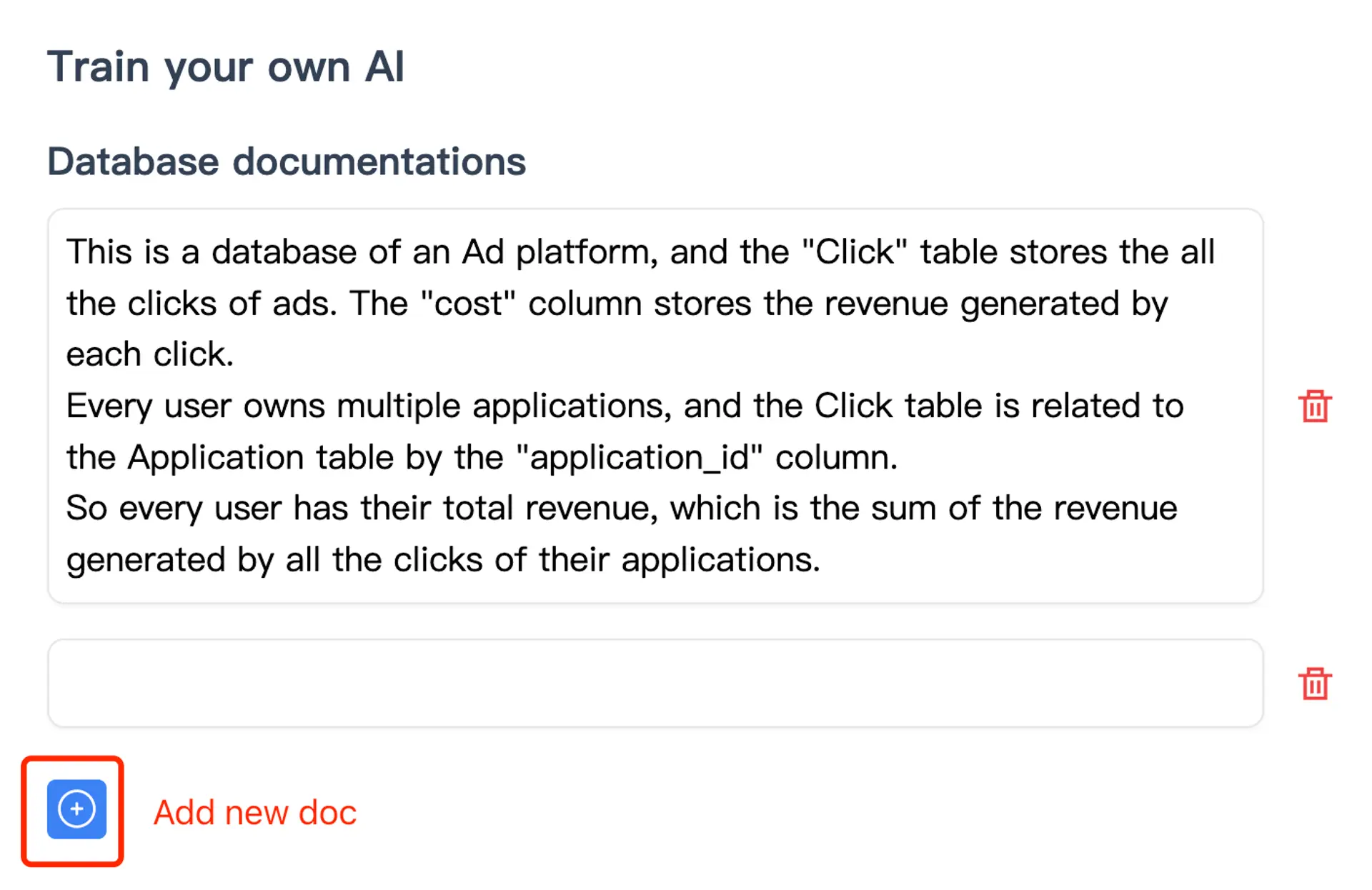
This screenshot illustrates AskYourDatabase's training workflow. It is not a Snowflake benchmark or evidence of a connection to your account. Training can convey business meaning; it does not grant database privileges or guarantee that every generated answer is correct.
4. Test questions before distributing the chatbot
Start with a small question whose result the data owner already knows. Ask to see the generated SQL, inspect the chosen objects and compare the result. Then change one condition at a time: period, status, grouping or a customer filter. Reconcile numbers before requesting a chart or export.
Use the text-to-SQL evaluation guide and downloadable reference kit to record expected answers, errors and regressions. Its local SQLite fixture is an independent reference exercise; adapt and verify queries for Snowflake rather than assuming cross-engine compatibility.
Worked example: latest order state versus duplicate revenue
Warehouse ingestion often preserves several versions of a business record. Consider this question:
Using the latest loaded version of each order, what is paid order revenue for August 2026? Amounts are USD cents. Exclude orders whose latest status is cancelled. This is a current restatement, not an August month-end snapshot.
The distinction matters. Order 102 was paid and later cancelled. Order 101's amount was corrected. Selecting all paid history rows would both duplicate an order and include revenue that should be excluded.
The following read-only Snowflake SQL uses inline synthetic rows. It creates no tables. The expected results were independently checked with local arithmetic; this SQL has not been executed in Snowflake, and no AI product was scored against it. Run and verify it in your own approved test environment before adapting it.
WITH order_versions (
  order_id, version_no, order_date, status, amount_cents
) AS (
  SELECT * FROM VALUES
    (101, 1, '2026-08-02', 'paid',      10000),
    (101, 2, '2026-08-02', 'paid',      12000),
    (102, 1, '2026-08-10', 'paid',       5000),
    (102, 2, '2026-08-10', 'cancelled',  5000),
    (103, 1, '2026-08-31', 'paid',       7000),
    (104, 1, '2026-09-01', 'paid',      90000)
), latest AS (
  SELECT *
  FROM order_versions
  QUALIFY ROW_NUMBER() OVER (
    PARTITION BY order_id ORDER BY version_no DESC
  ) = 1
)
SELECT
  COUNT(*) AS paid_orders,
  COALESCE(SUM(amount_cents), 0) AS paid_revenue_cents
FROM latest
WHERE status = 'paid'
  AND TO_DATE(order_date) >= DATE '2026-08-01'
  AND TO_DATE(order_date) < DATE '2026-09-01';
Expected result: 2 paid orders, 19,000 cents ($190.00). Order 101 contributes 12,000; order 103 contributes 7,000. Order 102's latest state is cancelled, and order 104 belongs to September.
Two plausible mistakes produce different wrong answers:
- Sum every August paid history row: 34,000 cents, including both versions of 101 and the outdated paid state of 102.
- Remove cancelled rows before selecting the latest version: 24,000 cents, incorrectly retaining 102's earlier paid version.
Snowflake's QUALIFY reference explains filtering after window functions. Here the first CTE selects the latest record per order; the outer WHERE applies reporting rules. Moving the status filter inside that selection changes the meaning.
In this fixture, version numbers are unique within each order. If your real data uses timestamps with ties, define a stable tie-breaker approved by the data owner. If the question asks for the state as of August 31, first restrict candidate versions to that cutoff using a trustworthy effective timestamp, then select the latest eligible version. The fixture has no such timestamp and cannot answer that historical question.
Add regression cases before rollout: changing 103 to cancelled should leave 12,000 cents and one paid order; September should return 90,000 cents and one order; July should return zero cents and zero orders. A request for margin cannot be answered from these columns because cost is absent. The assistant should explain the missing information rather than fabricate it.
Control query cost and data exposure
A restricted read role reduces write risk but does not bound warehouse consumption. Ask the warehouse owner to choose suitable warehouse size, suspension behavior and statement timeouts, and inspect query history while testing. LIMIT constrains returned rows, not necessarily the work needed to produce an aggregate.
Snowflake resource monitors can track assigned warehouse credits and trigger configured actions. They do not cover all serverless spending and are not a guarantee of an exact hard billing cap. Assess AI-service charges separately where applicable. The AYD connection fields above do not establish an automatic per-query spending cap.
Direct querying avoids a separate bulk import, but it does not mean all information stays inside Snowflake. Questions, schema context and relevant results may reach the assistant and AI processing services. Check which data is sent, retained or logged in the chosen deployment. Private deployment documentation distinguishes application hosting from model inference; do not assume on-premise hosting implies fully offline analysis.
Troubleshoot before broadening access
| Symptom | Check first | Avoid |
|---|---|---|
| Authentication fails | Account identifier, identity, PEM format and account authentication policy | Disabling MFA or sharing an administrator credential |
| Objects are missing | Role, selected database/schema, object grants and metadata visibility | Treating absent discovery results as an empty warehouse |
| Query cannot use a warehouse | Selected warehouse, USAGE and operational state | Granting broad administrative permissions |
| A total exceeds the finance report | Row grain, history versions, join cardinality, status and period | Hiding the discrepancy behind a chart |
| Repeated large queries consume credits | Query history, warehouse settings and appropriate timeouts | Assuming a small result set means a cheap query |
| A business user sees excessive data | Actual execution identity and database-enforced boundaries | Relying on a prompt to enforce authorization |
Move from evaluation to regular use
Choose a narrow reporting workflow and define an acceptance set with its owner. Record the SQL, expected result, actual result, latency and observed query cost for each case. Re-test after changing views, metric definitions, connector settings or model behavior. Keep unanswered and rejected questions in the record instead of counting only successful responses.
For adjacent warehouse evaluation, the BigQuery chatbot guide covers job permissions and nested-array totals. The natural-language database query guide explains the broader method. Snowflake-specific connection and version-selection checks remain in this guide.
Start with AskYourDatabase Desktop for a scoped internal evaluation, compare the plans and deployment choices, or use the embedded guide for a customer-facing project. Select a plan after confirming your access, reporting and data-processing requirements; this article does not promise a free plan, setup time or accuracy rate.
Frequently asked questions
How do I connect an AI chatbot to Snowflake?
Choose an approved reporting scope, configure a restricted Snowflake identity and warehouse, and enter the account identifier, database, user, authentication details, schema, warehouse and role in the connector. Validate object discovery and a known-answer query before adding business users.
Should I use Cortex or a connected Snowflake chatbot?
Evaluate the native Cortex route when Snowflake semantic views and its application ecosystem fit your team. Evaluate a connected assistant when you need its ready-made interface or other database connectors. Compare access control, metric definitions, answer quality and total operating cost with your own workload.
Does AskYourDatabase support Snowflake key-pair authentication?
The current web connection form accepts a PEM private key, and the Snowflake connector uses JWT authentication when a private key is supplied. Confirm the authentication options in your installed Desktop version and follow your administrator’s key-management policy.
Why can Snowflake revenue answers count the same order twice?
A history table may contain multiple versions of each order. Select the intended version before filtering status and summing revenue. Filtering paid rows before selecting the latest version can incorrectly retain an order that was later cancelled.
Does a read-only Snowflake role prevent expensive queries?
No. Read access can still execute large scans and joins. Have an administrator configure an appropriate warehouse, timeouts and warehouse resource monitoring, then inspect query history during evaluation. A row limit alone is not a cost guarantee.
Does a direct Snowflake connection keep all data inside Snowflake?
No. Direct querying avoids a separate bulk import, but schema, questions and relevant results may still be processed by the assistant and its AI services. Review the actual deployment’s data flow, retention and identity boundaries before connecting sensitive data.